14 February 2016

Week 3: PTO Terrain


Hello and welcome back to week three of the Behind Enemy Lines coverage of Flames of War: Pacific!

This week our theme is all about starting a PTO terrain project. We've got a checklist and branstorming article, a tutorial on making jungle patches, as well as an article about how to make and use scatter terrain in your games, so stay tuned!

Thanks for stopping by and make sure you stay up to date with the PTO community: https://www.facebook.com/groups/FoWPacific/

10 February 2016

PTO Early Start Models

by Mike

If you’re like me, you can’t wait to get started on some PTO armies! Luckily that’s possible with the already extensive miniature range from Battlefront.

While we’ll be waiting on new things like Marines and Corsairs, there are some models aready out there that will work for your PTO armies. Let’s have a look!


JBX01 Hohei Chutai box set
The Japanese
This is the easiest one to get started on. It virtually all there from the infantry to the tanks. The infantry and guns currently available are all ready to use and carry over from EW’s Rising Sun book. There will no doubt be new models here, but you can get your core done right now without any problems.

The tanks are mildly different as well, so using the old Type 89s and 95s is totally legit. In fact the Type 95 is really appropriate for forces like the SNLF. It was by far the most common tank seen in the USMC and US Army island hopping campaigns.

JBX02 Type 89 tanks

JBX03 Type 95 tanks

The Type 97 Chi-Ha is also more common than in Rising sun, so picking up a few of those won’t go amiss either. There are definitely some new tanks coming out as well, so leave some space in your armies for them. More on that in later articles!

JP051 Type 97 Chi Ha tank
All of the gun teams in the current range can be found and fielded in Banzai, so you can get started on your support weapons as well. There are a few new weapons, such as 81mm and 90mm mortars coming your way as well, so leave space for them!

So to put it shortly, as long as you stay away from mounted cavalry, the existing Japanese line is ready for you to get started on, straight away!


The USMC
The Marines fought with pretty much mid-war technology throughout the war, but they did get some new equipment in the later campaigns. This means there’s already a lot of vehicles ready to be assembled for your Marines, but for some this means looking outside the US line of miniatures into things like British or Soviet lend-lease stuff.

Obviously, the infantry and guns are going to be a new line, so you’ll need to hold on a little longer to get started on those. However, you can start getting going on vehicles now. Here’s a quick run-down of a few essentials:

M3A1 Stuart (US002)
The Stuart Light Tank
The Stuart was the USMC’s workhorse tank throughout the early campaigns. Even when the Sherman began arriving in larger numbers, the Stuart remained in service for a while, posing a threat to Japanese infantry and tanks right up until the end.

The Marines used M3, M3A1, and M5A1 light tanks during the war. As a side note, they also used M2A4 light tanks up to and including the Guadacanal campaign. The M2A4 looks nearly identical to an M3 after a little cosmetic surgery, so I might have a go at modelling one of these.

Anyway, you can grab the M3A1 and M5A1 from the current American models line. These will form the bulk of your Stuart tank needs and will prove more than a match for their Japanese opposites.

M5A1 Stuart (US005 for one, or UBX21 for a box of five)
For the M3, There's not an easy solution until Battlefront releases an M3 Stuart model. For now, you’ll need to go to the British to source the right turret for the M3, using the ‘Honey’ Stuart box set. Then match that up with an M3A1 hull and tracks. Unfortunately, you can't use the British ones right out of the box as the tracks aren't exactly right, You’ll need to source non-dust cover tracks. The ones found in the other Stuart models won't work without a little plasticard magic to cover the top of the tracks.

The Sherman Medium Tank
While the Sherman slipped behind the tank curve in the ETO, it never suffered that fate in the PTO, instead reaching a similar status to the Tiger I E or Panther on the other side of the world. Virtually indestructible, the Sherman was a force to behold in the Pacific, making its debut during the Battle of Tarawa in 1943.

A lend-lease M4A2 Sherman (SU071),
the same that the USMC used in 1943-44
The Marines used the diesel M4A2 Sherman in the Pacific for many campaigns before reluctantly upgrading to the M4A3 (late) models in 1944. These later models saw action from Saipan and on.

Modelling the M4A2 is relatively easy, but it’s not in the standard US miniatures range. Instead, the best place to find it is in the Soviet range, known as the M4 Emcha.

You can also use the British Sherman III, but for that one you’ll need to source some clean tracks without the sand guards and a turret without the tool box on the back.

M4A3 (late) Shermans (UBX44)
The M4A3 (Late) Shermans (and the 105mm version) can easily be picked up using the standard US models, either in plastic or metal/resin. Since the Sherman is a beast on the battlefield and it’s also expensive in points, so you’re not going to need a lot of them.

One tip would be to grab a single sprue (USO196) or two of the M4A3 (late) plastic kits to save some cash for more Marines.


Assault Guns
The Marines made use of assault guns often, ranging from the 75mm SPG (known as the M3 GMC 75mm in US Army terms) to the 105mm M7 SPG (aka M7 Priest). The 75mm one is recognizable from the Mid War Tank Destroyer Platoon, and can be purchased immediately. The same goes for the Priest, so those are two excellent choices for fire support. The crew in both kits are Army, but I don’t think there will be much of a distinction in the models once you paint the uniforms.


75mm SPG half-track
(aka 75mm GMC - US101)

105mm M7 SPG
(aka M7 Priest - US143)

2x LVT-4 Amtracs (BBX26)
Amphibious Assaults
Another staple of USMC and Army amphibious assaults is the LVT-4 armored personnel carrier. You can grab these from the British line. They’re crewed by British troops, but you can easily replace them with some US Half-track crew and even add some tank riders as passengers. But you may want to hold off on these as rumor has it they've been remade for the PTO release!

Not all assaults were conducted using LVTs, so you can use the more traditional LCVP Higgins boats and LCM landing craft. These will get your troops ashore in those amphibious assaults without the added points cost of an LVT. They're good for both ETO and PTO, so once you have some in your collection, that Normandy landing isn't going to be too difficult to pull off!

Also, don’t forget to stock up on DUKW amphibious trucks to haul your light guns ashore!


3x LCVP landing Craft (UBX08)

1x LCM (XBX05) 
Guns
There are some guns that you can buy now that are relatively “medium risk” in terms of getting the right figures for the job. The Marines had the full array of artillery support as the Army, from the humble M1A1 Pack 75mm howitzer to the 155mm “Long Tom” guns. Since the crew that comes with these guns don’t typically have webbing, they should look the part for USMC, after adding some special camo and appropriate PTO basing. The 105mm and 155mm howitzers and the 155mm gun are pretty straight forward. You might want to add some helmet covers for the gunners if you’re extra keen.

75mm Pack Howitzer (USO507)
The 75s are a little more complicated in that you’ll need to buy some M3 37mm guns and crews and swap the guns out for the M1A1 Pack 75s from the special order catalog. If you’re careful with figure placement, you might be able to get away with this trick I used for my ETO Soviet artillery and Saharan French guns so that you can swap the guns in and out depending on your list. However, you may want to have both!
In the PTO, there were always aircraft buzzing around overhead. Occasionally a Japanese airstrike would hit the Marines, so they were prepared with the typical array of Bofors, .50 cals, and 90mm guns. Like with the artillery, these are relatively safe to paint up as USMC if you want to provide a little aircover for your Marines.
Right, now that should be enough to get started while we wait for the USMC infantry to arrive and their unique support weapons, like the F4U Corsair. You should be able to break the back of your USMC support as well as complete an entire Japanese army, just with what’s already out there! Now, there’s no excuses so get to work!
 

08 February 2016

Pacific Battlefields in Flames Of War

by Mike

Perhaps my most favorite parts of Gung Ho and Banzai are the gaming and terrain articles. I’ve always enjoyed these parts of wargames books where the designers have spent some quality time outlining some ideas and suggestions to help make your games feel special and unique to really get you into the narrative of the game. It’s a bit like having a good set designer behind the curtain of a good play.

The Pacific is a truly unique battlefield for wargaming. We’ve had a taste with the Flames Of War Vietnam books, but this is so much bigger than that, including highlands on the mainland, jungles of southeast Asia, and island fighting. There is even different types of island fighting, such as atolls, volcanic islands, and more. It’s huge, which is why it’s so important that we have good guidelines to help us get on the right track and think laterally. Otherwise, I’d be inclined to see 100% of Pacific battles took place in thick jungles, which is simply not true. There is a lot of depth and diversity in Pacific battlefields, and I find that fascinating. The books have several interesting articles about the battlefields ranging from terrain rules to full scenarios. Let’s have a look at these great aspects of Gung Ho and Banzai.

Amphibious Assault Rules & Missions
Gung Ho includes special rules and scenarios for Pacific Amphibious Assaults. From what I can tell, it’s very similar to the D-Day amphibious assault rules with some modifications and a distinction between Atoll and Volcanic island assault “maps”.

The Volcanic island is identical to the usual Beach Landing scenario. Your normal beach table will suit this scenario just fine, though for beaches like Iwo Jima, the sand should be black.

The Atoll variant is a new one. This adds a bit of variety and a unique challenge to the beach landing scenario by lengthening the waterborne approach with the addition of Reef and Lagoon Zones between the land and sea zones. Lagoons form between the reef and shore, creating a sort of shallow pond or lake when the tide goes out. These regions pose navigational obstacles for incoming assault craft. The tides and the reefs were always a topic of close scrutiny during the planning phases of the assault, and likewise will they be on your table top. There’s a 33% chance that the reef will become a problem for the assaulting player, so landing craft might have to spend some time looking for a gap (losing a turn) or you can disembark from the landing craft and try to reach the beach on foot. It’s dangerous though as Bogging Down is instant death for teams in the Lagoon area!

Gung Ho includes two missions as well, one for each type of assault landing. The Island Landing mission covers volcanic island assaults, while the Atoll Landing mission (obviously) replicates the Atoll variant. The two missions use the rules described in the Amphibious Assault section. They look like they will provide some interesting variation to the usual Flames Of War missions. I tend to play at least one Normandy Beach assault per year (traditionally at the beginning of June), and the missions are always packed with action, things exploding, fresh waves of assault troops and gallant last stands. In the last ten years of this tradition, I’ve never seen a VP result better than a 4-3, indicating that the missions always end on a knife edge. Exciting and memorable games, each one and I can’t wait to finally through some Marines at the beach!

Refighting Battles of the Pacific
Throughout the two books, there are several featured battles. Following some informative history, there are some notes on how to recreate the interesting aspects of the battle or campaign. This is an awesome bit, perhaps the best in the whole book. I love this stuff, I really hope to see more of this sort of thing in future books. I intend to inflict this little campaign on the Behind Enemy Lines crew as soon as we get out force complete!


Guadalcanal
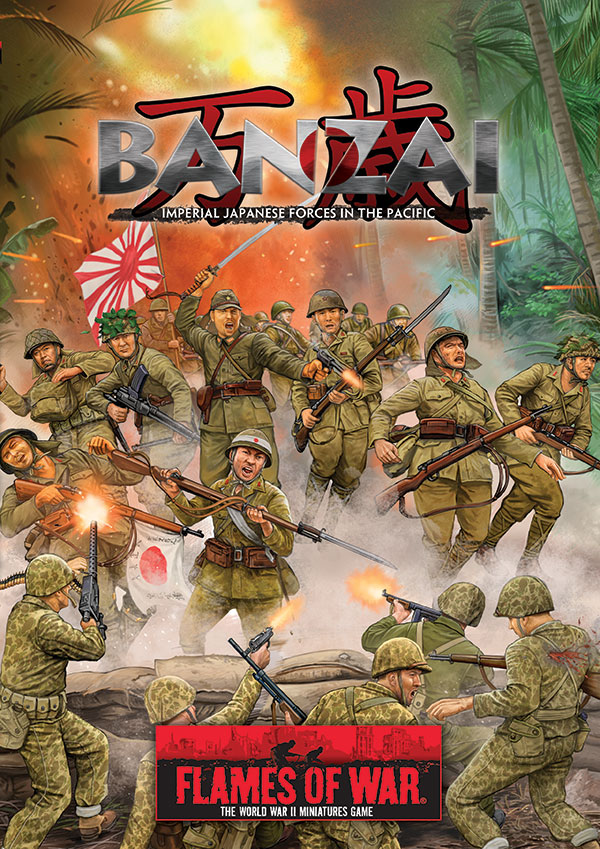
Banzai features the harsh campaign of Guadalcanal. In its refight notes, four highlights are presented, starting with Alligator Creek, to Edison’s Ridge, Henderson Field, and Mount Austen. For each battle the notes suggest some loose force organizations, things to include, and what to exclude.

They go on to suggest some appropriate missions as well. These look like great suggestions and I’ll be putting these on my gaming schedule!

Start your research about Guadalcanal here ...

Saipan
Gung Ho! features the Battle of Saipan and gives some excellent tips for recreating it on the table top. It outlines a loose campaign structure from the Island Landing mission, to a No Retreat mission for beach counterattacks (with the Japanese attacking), some night battles for the inland fighting, and a desperate final Banzai charge in a Free For All where all the Japanese forces are considered to start the game have drawn on its Seishin, imagine an entire army charging at the US Marines!

I’m pleased that this battle is spotlighted. I had a very close and personal friend who share his experiences in the Marine Corps on that island. He was the crew member of a Sherman flame-thrower tank and he had many harrowing stories to tell about his grim business and Japanese suicide tactics. Anyway, his stories have left an impression on me about Saipan and I’m pleased to finally dive into it to honor his memory.

If all goes well I'm going to get the guys play through this campaign!

Start your research about Saipan here ...

Iwo Jima
Like with Guadacanal,Banzai also features Iwo Jima, highlighting four moments. The players begin with a beach assault, consolidate the beachhead, endure nighttime Japanese counterattacks, finishing with a Japanese attack on Airfield #2. As with the others, I look forward to giving these battles a go.

What little I know of the battle come from some excellent Hollywood movies, such as the ubiquitous John Wayne classic, Sands of Iwo Jima and the powerful Letters from Iwo Jima. I'm excited to pull fact from fiction when I dive into this battle a bit more!

Start your research about Iwo Jima here ...

Okinawa
As with Saipan, Okinawa also has a great history and some notes on refighting it. Not so much presented as a narrative string of games, these notes give us some rules for tunnels and cave systems. This adds a whole new level to the game (literally) as the Japanese player can enter and leave cave mouths all across the table, making them difficult to pin down for any length of time! I’m keen to give this one a try!

Start your research about Okinawa here ...


Pacific Terrain
Finally at the back of Gung Ho is the Pacific terrain and battlefield section. I love these sections of Flames Of War books. They typically feature a table full of wonderful scenery, all set up for battle. Boxes are displayed around the table featuring the various terrain pieces and their respective special rules. I love building and setting up terrain, so I see these pages as the starting point for a massive “To Do” terrain list. As a completionist, I will insist on building anything that I don’t already have in my collection. I’ll show you what I mean soon in some upcoming terrain building articles!

The rules themselves are a collection of Vietnam and WWII terrain rules, nicely collected here in the back pages of Gung Ho!

Well that about covers our book reviews, now on to starting to build our armies!

07 February 2016

Week 2: A Brave New (Tropical) World!

Welcome back for another week of Behind Enemy Lines’ Flames of War: Pacific coverage! We hope you’ve enjoyed the book reviews of Gung Ho and Banzai. This week we’re excited to bring you an in-depth look about what the books say about wargaming in this new theatre. Later we’ll have a look at the existing Battlefront range and identify what you can currently get to dive into the PTO before the Marines arrive on the shelves of your local friendly retail shop.

Also, in case you missed it, here’s a video we uploaded over the weekend of me un-blistering a Marine Assault Engineer Platoon (and a dog team!), go have a look!


Thanks for stopping by and make sure you stay up to date with the PTO community: https://www.facebook.com/groups/FoWPacific/


06 February 2016

USMC Assault Section

Today on YouTube, Mike has the pleasure of getting his hands on something he's been waiting a long time for....MARINES!

Come and have a look!!